
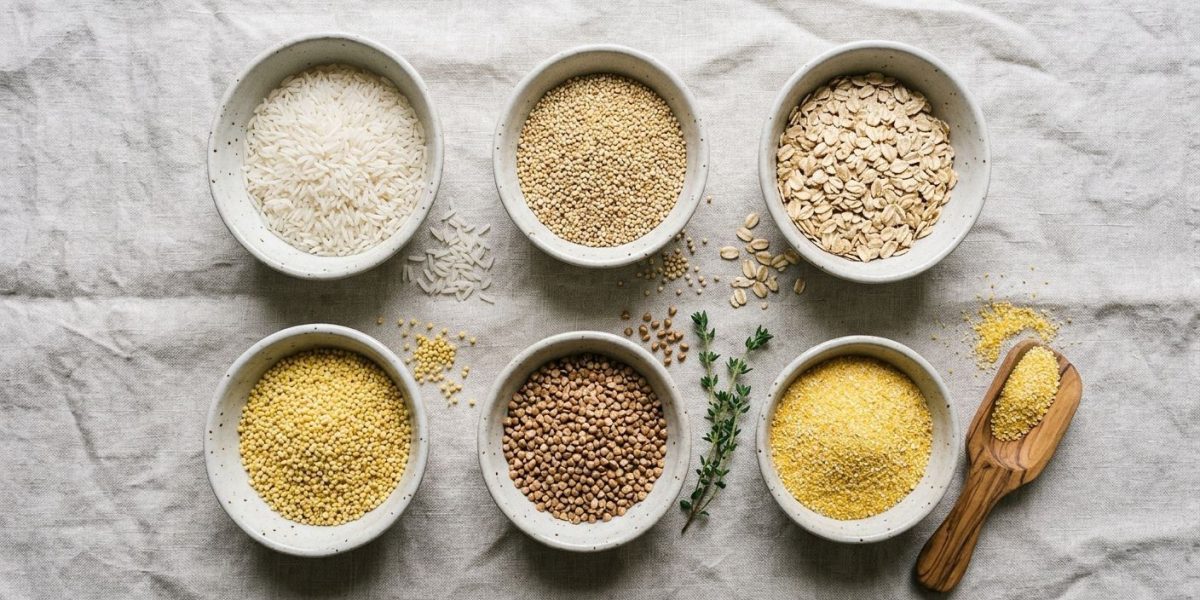
Grains are one of the easier food groups on a low histamine diet, which is good news, because they end up doing a lot of work once tomatoes, aged cheese and cured meat are off the menu. Most low histamine grains are plain staples you already know: rice, oats, quinoa, millet, buckwheat, corn and pasta. The trouble starts with what happens to grains after they leave the bag, through fermentation, yeast, long storage of cooked leftovers and the sauces they are served with. This guide rates the common grains on our food list, explains why bread is treated differently from rice, and covers the cooking and storage habits that help keep a simple bowl of grains low in histamine.
Every rating here comes from our histamine intolerance food list, which uses three levels: Low, Moderate (test) and High. Where a grain is not rated on our list, we say so and suggest treating it as a test food.
The short answer. Rated Low: rice (white, brown and wild), oats, quinoa, millet, buckwheat, amaranth, corn and polenta, and fresh or dried pasta. Rated Moderate (test): yeasted bread and wheat germ. Rated High: sourdough bread, because of its long bacterial fermentation. Rye, spelt, barley and teff are not rated individually on our list.
The Grain Rating Table
Our list defines Low as foods that are usually well tolerated during an elimination phase when fresh, Moderate (test) as foods that some people react to and others do not, and High as foods that usually contain a lot of histamine or related amines. Grains sit mostly in the first group.
| Grain or grain food | Rating on our list | Notes |
|---|---|---|
| Rice: white, brown and wild | Low | Cool leftovers quickly and freeze |
| Oats and porridge | Low | Plain oats, not flavored instant sachets |
| Quinoa | Low | Rinse before cooking |
| Millet | Low | Mild, good for porridge |
| Buckwheat | Low | Not related to wheat and naturally gluten free |
| Amaranth | Low | Small seeds, cooks to a porridge texture |
| Corn and polenta | Low | Check corn products for added flavorings |
| Fresh and dried pasta | Low | The sauce is usually the problem, not the pasta |
| Yeasted bread | Moderate (test) | Some people react to yeast |
| Wheat germ | Moderate (test) | Test on its own |
| Sourdough bread | High | Long bacterial fermentation |
| Rye, spelt, barley, teff | Not rated | Treat as test foods |
Two things are worth noticing. First, every grain rated Low is a plain grain, or a simple grain product such as pasta, with no fermentation step. Second, the two grain foods that move up the scale, yeasted bread and sourdough, are both made with a fermentation step. That pattern runs through much of the low histamine diet: fermentation, ageing and storage often matter more than the basic ingredient.
What the Research Says About Grains
The honest answer is that grains are not well studied for histamine. A useful source on measured histamine in foods, a 2021 review in Nutrients titled Low-Histamine Diets: Is the Exclusion of Foods Justified by Their Histamine Content?, compared ten published low histamine diets with a large database of amine measurements. It found that 68% of the foods those diets excluded did not show significant histamine levels in any sample, and the highest histamine values in its data were in fermented foods such as soy-fermented products, dry-fermented sausages and cheese. It did not report data for cereals, rice or oats at all.
A 2020 review in Biomolecules, Histamine Intolerance: The Current State of the Art, makes a related point: there is no single standard low histamine diet, fermented products are systematically excluded, and published diets vary widely on which other foods they cut. Cereals are not a focus of that review either.
So grain ratings rest mostly on how the grain is processed rather than on direct measurement. Plain grains are rated Low because they are low-moisture foods with no fermentation step. Sourdough is rated High because its long bacterial fermentation is the kind of process that lets histamine build up, and both reviews describe bacterial activity as the main source of histamine in food. Yeasted bread is rated Moderate (test) because some people react to yeast. Where the evidence is thin, our list says test, and so do we.
Rice, the Easiest Starting Point
Rice is rated Low on our list in all its usual forms, white, brown and wild. It is cheap, filling and pairs with almost every low histamine protein and vegetable, which is why it turns up in so many of our low histamine dinner recipes.
The catch with rice is leftovers, for two separate reasons. The first is histamine: histamine can build up in cooked food during storage, and reheating does not remove it. The second is food safety: cooked rice is a well-known source of food poisoning from Bacillus cereus, a bacterium whose spores survive cooking and can multiply when cooked rice is left warm. Both problems have the same fix, which is to cool cooked rice quickly and freeze what you will not eat soon.
- Cook only as much rice as you need, or plan to freeze the extra.
- Spread leftover rice on a tray or in a shallow container so it cools fast.
- Refrigerate or freeze it within two hours of cooking, or within one hour above 90°F (32°C).
- Freeze rice in single portions and reheat each portion once, until steaming hot (165°F or 74°C).
Brown rice keeps more of the bran and germ than white rice, and some people find it harder to digest. That is a fiber question, not a histamine one. Both are rated Low.
Oats and Porridge
Plain oats are rated Low on our list, and a bowl of freshly cooked porridge is one of the simplest low histamine breakfasts. Rolled oats, steel-cut oats and oat flour all count as plain oats. Flavored instant sachets are a different product: check the label for dried fruit, chocolate, flavorings and milk powders, and choose plain oats when you can.
Overnight oats raise a fair question. Soaking oats in the fridge for many hours is common, but our low histamine breakfast ideas suggest cooking porridge fresh in the morning instead of soaking it overnight, as a cautious habit during the elimination phase. If you want to try overnight oats later, test them like any other food.
Oats do not contain gluten but are often processed alongside wheat, so people with coeliac disease are usually advised to choose oats labelled gluten free, and a small number react even to pure oats. That is a separate issue from histamine, and a doctor or dietitian can advise on it.
Quinoa, Millet, Buckwheat and Amaranth
These four are sometimes called pseudocereals or ancient grains, and all of them are rated Low on our list. They are useful for two reasons: they add variety to a diet that can feel repetitive, and quinoa and amaranth in particular are popular protein-rich options for people who eat little meat.
Quinoa
Quinoa cooks in about 15 minutes. Rinse it well in a fine sieve first to remove its bitter natural coating, then simmer one part quinoa in two parts water with a pinch of salt until the water is absorbed and the grains show a little white tail. It works in salads, bowls, stuffed peppers and soups, and it thickens a pot of stew nicely.
Millet
Millet has a mild, slightly sweet flavor. Toast it in a dry pan for a few minutes before simmering for a nuttier result, or cook it with extra water for a soft porridge. It makes a good change from rice under a stir-fry.
Buckwheat
Despite the name, buckwheat is not related to wheat and is naturally gluten free. Toasted buckwheat (kasha) has a strong, earthy flavor, and buckwheat flour makes good pancakes. Our breakfast guide uses buckwheat pancakes with fresh berries as one of its ideas; blueberries and blackberries are rated Low on our list.
Amaranth
Amaranth seeds are tiny and cook to a porridge-like texture rather than separate grains. It is best used as a breakfast porridge or stirred into soups.
Corn and Polenta
Corn and polenta are rated Low on our list. Plain cornmeal, polenta, corn on the cob, frozen corn kernels and plain corn tortillas all fit within that rating. As with oats, the risk sits in processed corn products: flavored tortilla chips, ready-made polenta with cheese, corn snacks with seasoning, and cornbread mixes made with buttermilk. Read the ingredients and look for cheese powder, yeast extract, vinegar and tomato powder.
Polenta is especially handy because it takes the place of bread or pasta at dinner. Cook it soft and serve it with roast chicken and greens, or let it set in a tray, slice it and pan-fry the slices until crisp.
Pasta and Noodles
Fresh and dried pasta are both rated Low on our list. For most people the pasta itself is not the issue. The usual problems are tomato sauce, parmesan, pesto with aged cheese and cured meat. Our low histamine pasta recipes show how to build sauces around olive oil, fresh herbs, vegetables and fresh soft cheese instead.
Plain rice noodles and 100% buckwheat noodles are made from grains rated Low, although noodles are not rated separately on our list. Check soba noodles, since many brands blend buckwheat with wheat, and avoid noodle kits that come with a soy sauce or stock sachet, both of which are rated High.
Why Bread Is Different
Bread is where grains stop being simple. Yeasted bread is rated Moderate (test) on our list, with the note that some people react to yeast, and sourdough is rated High because of its long bacterial fermentation. That can be surprising, since sourdough is often marketed as the healthier, easier-to-digest choice. For histamine, the long fermentation works against it.
If bread is important to you, there are three routes:
- Quick breads. Breads raised with baking powder or baking soda instead of yeast skip the fermentation step. Soda bread needs an acid to react with the baking soda; use cream of tartar rather than buttermilk, which is fermented.
- Flatbreads. Simple unleavened flatbreads made from flour, water, oil and salt cook in minutes in a dry pan.
- Testing yeasted bread later. Once your symptoms have settled, a fresh loaf of plain yeasted bread is a reasonable test food. Choose a fresh, plain loaf with a short ingredient list, as a cautious habit.
Our low histamine bread recipes include quick breads, flatbreads and a few yeasted options for later. Some shop-bought breads contain vinegar as a preservative, so check the label for it.
Rye, Spelt, Barley and Other Unrated Grains
Several grains are not rated on our list: rye, spelt, barley, teff, farro, sorghum and freekeh. There is no strong reason to think the plain grains are high in histamine, but the reviews we rely on do not include measured data for them. The practical approach is to leave them out of the first weeks and test them one at a time later.
Watch how they are used, too. Rye often appears as sourdough rye bread, which falls under the High sourdough rating. Barley is the main grain in beer and malt products, which are fermented. Malt vinegar is vinegar. In each case the processing, not the grain, is what moves the food up the scale.
Gluten Free Is Not the Same as Low Histamine
Many low histamine grains happen to be gluten free: rice, quinoa, millet, buckwheat, amaranth and corn. That overlap leads some people to think the two diets are the same. They are not. Gluten is a protein, while histamine is an amine produced mainly by bacterial activity in food. Wheat pasta is rated Low for histamine even though it contains gluten, and a gluten free sourdough is still a fermented bread.
If you suspect a problem with gluten, speak to your doctor before cutting it out. Testing for coeliac disease is most reliable while you are still eating gluten, so removing it first can make diagnosis harder.
Cooking Grains Without Adding Histamine
Grains are usually low in histamine, but the way they are cooked can add it back. A few habits make the difference.
- Cook in water, not stock. Stock cubes, bouillon and bone broth are rated High on our list. A pinch of salt, a bay leaf and a knob of butter or a splash of olive oil give rice and quinoa plenty of flavor. Our article on bone broth histamine content explains why broth is a special case.
- Season with fresh herbs. Parsley, coriander, basil and thyme are rated Low and lift a plain grain bowl.
- Skip soy sauce and vinegar. Both are rated High. Fried rice and grain salads often rely on them.
- Use dry grains you buy in reasonable amounts. Store them in airtight containers in a cool, dry cupboard. Throw away anything that smells musty or shows signs of moisture or insects.
Leftovers, Batch Cooking and the Freezer
Batch cooking grains saves a lot of time on a low histamine diet, as long as the batch goes into the freezer rather than the fridge. The USDA leftovers and food safety guidance says cooked food should be refrigerated within two hours, or one hour above 90°F (32°C), and that large amounts should be divided into shallow containers so they cool quickly. It gives three to four days in the fridge, but that is a food safety limit, not a histamine guide.
A low histamine routine looks like this:
- Cook a pot of rice, quinoa or millet.
- Spread what you will not eat now on a tray to cool for a few minutes.
- Pack it into single portions in bags or containers and freeze.
- Reheat a portion from frozen until steaming hot (165°F or 74°C), and eat it that day.
Freezing does not remove histamine that has already formed, so speed matters more than the freezer itself. This is a common precaution in low histamine eating rather than a tested threshold. Our low histamine meal prep guide explains the freeze-first system in detail.
Five Simple Grain Meals
These are templates rather than full recipes, built mainly from foods rated Low on our list.
- Chicken and herb rice bowl. Freshly cooked rice, roast chicken thighs, cucumber, a big handful of parsley and coriander, and olive oil with salt.
- Warm quinoa salad. Quinoa with roasted butternut squash, zucchini, toasted pumpkin seeds and torn fresh mozzarella.
- Soft polenta with greens. Polenta cooked in water with butter and salt, topped with garlic-sautéed kale and an egg fried until the white and yolk are fully set.
- Millet porridge. Millet simmered with water or fresh milk, finished with sliced pear and a little maple syrup.
- Quinoa in chili. A handful of quinoa thickens a tomato-free pot of chili, as in the vegetable version of our low histamine chili.
For more ideas, our low histamine lunch ideas and the histamine intolerance meal plan build whole days around these staples, and our low histamine vegetables guide rates the produce that goes with them.
How to Test an Unrated Grain or Bread
Testing is how a Moderate (test) or unrated grain earns a place in your diet. Wait until your symptoms have settled on the Low group, and then keep it simple.
- Choose one food, such as plain cooked barley or a slice of fresh yeasted bread.
- Eat it with a meal you already tolerate, and change nothing else.
- Start with a small portion, and note any symptoms over the next day.
- If all is well, try a normal portion a few days later.
- Leave a clear gap before testing the next food, so reactions do not overlap.
Bloating after a new grain is not always about histamine. A sudden increase in fiber, wheat-based fructans and simply eating a larger meal can all cause digestive symptoms. If you have ever had a severe reaction to a food, speak to your doctor before testing at home. Our guide to how long to stay on a low histamine diet covers reintroduction in more depth.
When to See a Doctor
A low histamine diet is a tool for managing symptoms, not a diagnosis. Talk to your doctor if you have frequent digestive symptoms, flushing, hives, headaches or palpitations after eating, because coeliac disease, food allergy and other conditions can look similar. Unexplained weight loss, blood in the stool, persistent diarrhea or ongoing tiredness need medical assessment rather than a diet change. If you are pregnant or planning meals for a child, discuss a restrictive diet with a doctor or dietitian first.
Swelling of the lips, tongue or throat, difficulty breathing or swallowing, wheezing, or feeling faint after eating can be signs of anaphylaxis. Call emergency services immediately. If you have been prescribed adrenaline (epinephrine), use it first. Antihistamines are not a substitute.
Common questions about low histamine grains
Which grains are low histamine?
On our food list, rice (white, brown and wild), oats, quinoa, millet, buckwheat, amaranth, corn and polenta, and fresh or dried pasta are rated Low. Yeasted bread and wheat germ are rated Moderate (test), and sourdough bread is rated High because of its long bacterial fermentation.
Is oatmeal low histamine?
Plain oats and porridge are rated Low on our food list. Cook porridge fresh rather than keeping it for days, and choose plain oats over flavored instant sachets, which can contain dried fruit, chocolate or flavorings.
Are grains high in histamine?
Plain grains are generally rated Low, and a major 2021 review of measured histamine in food did not report data for cereals. Grain foods move up the scale when they are fermented, which is why sourdough bread is rated High and yeasted bread is rated Moderate (test) on our list.
Is rice OK on a low histamine diet?
Yes. White, brown and wild rice are rated Low on our food list. Cool leftover rice quickly and freeze it in portions, both to limit histamine build-up and because cooked rice left warm can cause food poisoning from Bacillus cereus.
Is gluten free the same as low histamine?
No. Gluten is a protein, while histamine forms mainly through bacterial activity in food. Wheat pasta is rated Low for histamine on our list, and a gluten free sourdough is still fermented. If you suspect a gluten problem, talk to your doctor before cutting gluten out.
Medical disclaimer: This content is for informational purposes only and does not constitute medical advice. Always consult a qualified healthcare provider before starting any supplement regimen.
→ Try the Histamine Load Calculator — find out if your daily food choices are pushing you over your histamine threshold.
→ Track your reactions with the Histamine Food Diary — identify your personal trigger foods automatically.
→ Ready to start? Use the 4-Week Elimination Diet Planner — interactive daily tasks with progress tracking.
→ Build your meal with the Low Histamine Meal Builder — instant histamine scoring as you select ingredients.