
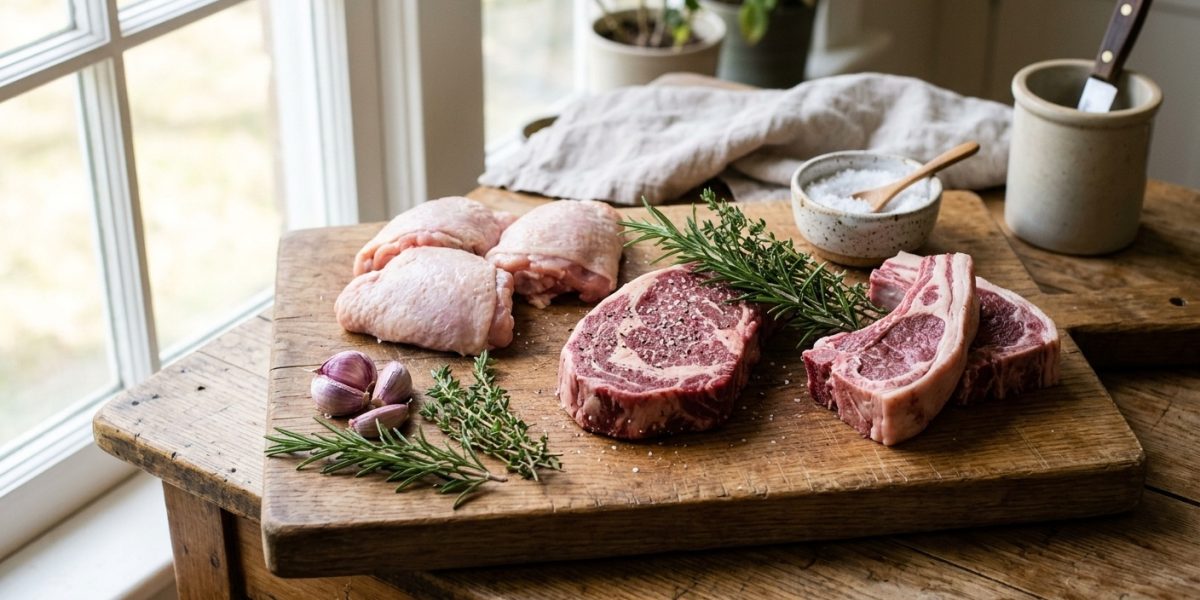
Any low histamine meat list has to answer a simple question: is the meat itself the problem, or is it the age of the meat, the curing and the sauce? On our rating, plain fresh chicken, turkey, beef and lamb sit in the Low group, pork and mince need testing, and cured, smoked and fermented meats are the ones to skip. This guide sorts every common meat using the ratings on our histamine intolerance food list, shows what measured data does and does not say, and covers the buying, cooking and freezing habits that decide how a piece of meat behaves on your plate.
The short answer. Rated Low: fresh chicken and turkey, fresh beef and lamb (whole cuts, not dry-aged). Rated Moderate (test): fresh pork, freshly minced meat, liver and other offal, and leftover cooked meat. Rated High: bacon, ham, salami, chorizo, sausages, hot dogs, and bone broth or stock.
The Meat Rating Table
Our food list defines its ratings in three steps. Low means the food is usually well tolerated during an elimination phase when it is fresh. Moderate (test) means some people react and some do not. High means the food usually contains a lot of histamine or related amines. The pattern across meat is clear: the problems start with ageing, curing, smoking, mincing and long storage.
| Meat | Rating | Notes |
|---|---|---|
| Fresh chicken and turkey | Low | Cook within a day of purchase or freeze |
| Fresh beef and lamb | Low | Whole cuts are safer than mince, and dry-aged beef is the exception to avoid |
| Fresh pork | Moderate (test) | Test it after the first weeks |
| Freshly minced meat | Moderate (test) | Cook it the day it is minced |
| Liver and other offal | Moderate (test) | Only very fresh offal is worth testing |
| Leftover cooked meat | Moderate (test) | Freeze portions straight after cooking |
| Bacon, ham, salami, chorizo | High | Cured, smoked or fermented |
| Sausages and hot dogs | High | Often contain cured meat, spices and additives |
| Bone broth and stock | High | Rated High on our list |
Two foods that people expect on a meat list are not rated individually. Game meat does not have its own row, and sliced deli meat is not rated either, so both are covered below, and both stay out of the first weeks. If you cook a lot of chicken, our low histamine chicken recipes put the Low rating to use with ten simple dishes.
Fresh Chicken and Turkey, the Safest Starting Point
Poultry is the easiest place to start because our list rates fresh chicken and turkey Low, and because the cooking rules are simple. The rating comes with a condition: cook within a day of purchase or freeze. A chicken breast that was packed on Monday and cooked on Friday falls outside that advice.
Poultry also has the highest food safety temperature of any meat. Ground poultry and whole poultry need to reach 74°C (165°F), measured with a food thermometer, and juice colour is not a reliable sign. Chicken thighs, breasts, drumsticks and whole birds all qualify, and so does turkey. For a holiday-sized bird, our low histamine thanksgiving plan walks through buying, thawing and the leftover freezer routine.
Beef and Lamb, and Why Whole Cuts Beat Mince
Fresh beef and lamb share one row on our list, and both are rated Low. The notes carry two conditions. First, whole cuts such as steaks, roasts and chops are safer than mince. Second, avoid dry-aged beef. Dry ageing is a deliberate hanging period, and our list names ageing as a problem, so a dry-aged steak is a different product from a fresh one.
This is a place where asking a question pays off. A butcher can tell you whether a cut has been hung or aged, how long it has been on the counter and when it arrived. For a supermarket pack, look at the date and choose the freshest one. Lamb chops, a lamb shoulder, beef steaks and a pot roast from a fresh joint all work, and our low histamine slow cooker recipes and low histamine one pan dinners show how to cook them with fresh herbs and vegetables instead of stock cubes.
Pork, Mince and Offal, the Test Group
Three meat foods sit in the Moderate (test) band, which means foods to introduce one at a time. They are not necessarily off the list for good, but they are not first-weeks foods.
Fresh pork
Our list rates fresh pork Moderate (test) and notes that many lists rate it lower than poultry. That makes it a sensible second step once chicken, turkey, beef and lamb are going well. Choose a fresh whole cut such as a loin chop or a roast, cook it to 63°C (145°F) with a three minute rest, and treat the first portion as a test. Cured pork products such as bacon and ham are a separate, High-rated category, covered in a later section.
Freshly minced meat
Mince is rated Moderate (test) because the grinding exposes more surface to bacteria than a whole cut does, so it gains histamine faster. Our list says it is fine for many people if it is cooked the day it is minced. In practice that means buying mince on the day you cook it and cooking it that day. Ground meat should reach 71°C (160°F), and ground poultry 74°C (165°F). Burgers, meatballs and a bolognese made without tomato are all affected by the same rule.
Liver and other offal
Our list notes that liver and other offal spoil quickly and says that only very fresh offal is worth testing. If you want to try it, buy it on the day you plan to cook it, cook it that day and do not keep it for later. If you cannot guarantee freshness, skip it.
Cured, Smoked and Fermented Meat Is the Real Hazard
If you only remember one rule from this guide, remember this one. Bacon, ham, salami and chorizo are rated High on our food list because they are cured, smoked or fermented. Sausages and hot dogs are also High, because they often contain cured meat, spices and additives. All of these are usually avoided during elimination.
The High ratings here come mainly from how the meat is processed, not from the species. Deli meat is not rated as a category. Anything cured, smoked or fermented falls under the High group above, so leave deli meat out of the first weeks. Read the ingredients for signs of curing or smoking, and for yeast extract, vinegar and spice blends, and see our guide to hidden histamine in food and the longer high histamine foods to avoid list for the ready-made products that quietly contain them.
What the Measured Data Actually Shows
The best single source for measured histamine in food is a 2021 review in Nutrients, Low-Histamine Diets: Is the Exclusion of Foods Justified by Their Histamine Content?, which drew on a database of amine measurements in foods on the Spanish market and compared them with ten published low histamine diets. Its meat results are short, and they are broadly consistent with our list.
| Product | Samples | Average histamine | Range |
|---|---|---|---|
| Fresh meat | 199 | Not detected | Not detected |
| Cured meat | 23 | 4.9 mg/kg | Not detected to 150 mg/kg |
| Dry-fermented sausages | 424 | 21.6 mg/kg | Not detected to 474.8 mg/kg |
Three things stand out. First, histamine was not detected in the 199 fresh meat samples. Second, cured meat and dry-fermented sausages did contain histamine, and the ranges are wide: some samples had none and some had much higher values. Third, the paper explains that for fresh, cooked and cured meat, the absence of histamine is expected so long as freshness and correct hygienic conditions are guaranteed. It also notes that fresh meat and cured meat were excluded by only three and two of the ten low histamine diets, while the diets all excluded fermented foods.
The limits matter too. The data comes from one country, the review did not break fresh meat down by species, and it has no figures for pork, lamb, offal or minced meat on their own. Where the data is thin, our list says test, and we follow it.
Buying and Storing Meat
Our food list states the mechanism plainly: histamine forms when bacteria break down the amino acid histidine, so it builds up as food ages, even in the fridge. That is why almost every habit that follows is about time.
- Buy close to the day you cook. For poultry, our list says to cook within a day of purchase or freeze.
- Choose whole cuts over mince. Mince has more surface for bacteria, so buy it on the day you cook it.
- Ask about ageing. A butcher can tell you whether beef was dry-aged, and dry-aged beef is the exception on our list.
- Freeze on the day you buy. If you will not cook the meat tomorrow, freeze it in single portions rather than leaving it in the fridge. Our list says this for poultry, and it is a common precaution for other fresh meat.
- Keep raw meat away from other food. Use a separate board and wash your hands after handling it.
Game meat is not rated on our list. Ask the seller how it was handled, and leave it until after the first weeks. Canned meat is not rated either, and the product can matter as much as the meat, so check the label for stock, yeast extract and added flavourings.
Cooking Temperatures and Methods
Histamine is heat stable, so roasting, frying, grilling or boiling will not remove histamine that is already in a food. Cooking is what makes meat safe from harmful bacteria, and freshness is what keeps histamine low, so the two jobs are separate. Use a food thermometer and follow the safe minimum internal temperatures from FoodSafety.gov.
| Meat | Minimum internal temperature |
|---|---|
| Chicken and turkey, whole or ground | 74°C (165°F) |
| Beef, lamb and pork steaks, chops and roasts | 63°C (145°F), then rest for 3 minutes |
| Ground beef, lamb and pork | 71°C (160°F) |
| Leftovers, when reheated | 74°C (165°F) |
Roasting, pan frying, grilling, poaching and quick stir-frying are all good methods. Olive oil, salt and fresh herbs give plenty of flavour without anything that needs a label check. The method matters less than the starting point.
Leftover Cooked Meat and the Freezer
Our list rates leftover cooked meat Moderate (test), because histamine rises with storage time and cooking does not remove it. The USDA leftovers and food safety page says cooked food must be refrigerated within two hours, or within one hour if the temperature is over 32°C (90°F), kept in the fridge for no more than three to four days, and reheated to 74°C (165°F). That is a food safety ceiling, not a histamine guide, and histamine builds up as food ages. Reheat only once, to 74°C.
For histamine, the practical route is the one our list suggests: freeze portions straight after cooking. Slice or portion the meat, let it cool quickly, pack it in single servings, and refrigerate or freeze within two hours of cooking (one hour above 32°C). That is a common precaution in low histamine eating and not a tested threshold, and freezing does not remove histamine that has already formed. Frozen leftovers stay safe from a bacterial point of view indefinitely, according to the USDA, though quality drops over time. Our low histamine meal prep guide explains a freeze-first routine in detail.
Stock, Broth, Marinades and Seasonings
Many people choose the right meat and then add a High-rated ingredient. Bone broth and stock are rated High on our list, and stock cubes and yeast extract are High as well, so a stew, gravy or soup built on any of them changes the rating of the meal. Our article on bone broth histamine content covers why broth is a special case. For a savoury base, use water, salt, onion, garlic and fresh herbs, and see our low histamine soup recipes for ways to build flavour without stock.
Marinades and seasonings need the same attention. Soy sauce is fermented and rated High, vinegar is on our avoid list during elimination, and spice blends vary. Cinnamon, cloves, nutmeg, chilli, paprika and curry blends are rated Moderate (test) on our list, so keep the first weeks simple with olive oil, salt and fresh herbs. Our low histamine sauces and condiments cover the swaps.
How to Test a Borderline Meat
Testing is how a Moderate (test) meat either earns a place on your plate or stays off it. Wait until your symptoms have settled on the Low group, and then follow a simple routine.
If you have ever had a severe reaction to a food, speak to your doctor before testing at home, and stop and follow the emergency advice below if you notice any signs of anaphylaxis.
- Pick one meat, such as fresh pork or freshly minced beef, and test only that.
- Buy it fresh, cook it plainly, and do not add sauce, stock, vinegar or other test foods.
- Eat a small portion first, and note when any symptoms start.
- Write down the meat, where you bought it, how long it was stored and any symptoms, so a pattern can show up.
- Leave a clear gap before the next test, so two foods cannot blame each other.
If you react, the meat is not necessarily gone for good, since some people find their tolerance changes, and a reaction may also point to how old or how processed that particular product was. A doctor or dietitian can help you tell a histamine reaction from an allergy or a digestive issue, and our article on how long to stay on a low histamine diet covers the longer arc.
A Week of Meat Meals Without the Hazards
It helps to think in templates, not recipes. A whole chicken roasted with root vegetables gives a dinner and freezable portions. Lamb chops or a beef steak with steamed greens and potatoes is a fast weeknight meal, and a pot roast from a fresh joint built on onion, carrot, herbs and water suits a slow cooker or our low histamine instant pot recipes. Cool any leftovers quickly and freeze them in portions. Our low histamine dinner recipes and the histamine intolerance meal plan show how these fit into a full week, and the vegetable side is covered in our guide to low histamine vegetables.
Eating out is harder, because you cannot see how long the meat was stored or what went into the sauce. Our low histamine restaurant card gives you a short, polite way to ask for plain grilled or roasted meat without stock, marinade or sauce.
When Meat Is Not the Problem
Symptoms after a meat meal do not always mean histamine. The sauce, the stock cube, the side dish, the wine and the leftovers from yesterday can also be the cause, and large, rich meals can cause discomfort for reasons unrelated to histamine. If a meal that contained only Low-rated foods still causes symptoms, that is worth discussing with a doctor, because food allergy and other conditions can look similar.
Cutting out many foods without need can also leave you short of nutrients. Keep the list of foods you avoid as short as your results justify, and widen it again as soon as you can.
When to Get Medical Help
Flushing, headache, a blocked nose or a racing heart after a meal can have several causes, including allergy, so discuss recurring symptoms with your doctor before building a long list of avoided foods. A restrictive diet is worth discussing with a doctor or dietitian first if you are pregnant, losing weight without trying, or planning meals for a child.
Swelling of the lips, tongue or throat, difficulty breathing or swallowing, wheezing, a hoarse voice, or feeling faint, pale or floppy can be signs of anaphylaxis. Call emergency services immediately, even if you feel better. If you have been prescribed adrenaline (epinephrine), use it first. Antihistamines are not a substitute.
Meat questions people ask
Is chicken low in histamine?
Fresh chicken and turkey are rated Low on our food list, with the note to cook within a day of purchase or freeze. The rating describes fresh meat, so chicken that has sat in the fridge for days falls outside that advice.
Is beef high in histamine?
Fresh beef is rated Low on our food list, and whole cuts are safer than mince. Dry-aged beef is the exception to avoid, because our list names ageing as a problem for histamine.
Is pork low histamine?
Fresh pork is rated Moderate (test) on our food list, which means some people react and some do not. Try it after the first weeks, once your symptoms have settled on poultry, beef and lamb.
Is minced meat okay on a low histamine diet?
Freshly minced meat is rated Moderate (test). Mince has more surface area for bacteria than a whole cut, so it is fine for many people if it is cooked the day it is minced, and it should be cooked to 71°C (160°F).
Can I eat bacon, ham or sausages?
Not during elimination. Bacon, ham, salami, chorizo, sausages and hot dogs are rated High on our food list because the meats are cured, smoked or fermented, and sausages and hot dogs often contain cured meat, spices and additives.
Is bone broth low histamine?
No. Bone broth and stock are rated High on our food list. If you want a savoury base, use plain water with fresh herbs and salt, and see our bone broth article for the full reasoning.
Medical disclaimer: This content is for informational purposes only and does not constitute medical advice. Always consult a qualified healthcare provider before starting any supplement regimen.
→ Try the Histamine Load Calculator — find out if your daily food choices are pushing you over your histamine threshold.
→ Track your reactions with the Histamine Food Diary — identify your personal trigger foods automatically.
→ Ready to start? Use the 4-Week Elimination Diet Planner — interactive daily tasks with progress tracking.
→ Build your meal with the Low Histamine Meal Builder — instant histamine scoring as you select ingredients.