
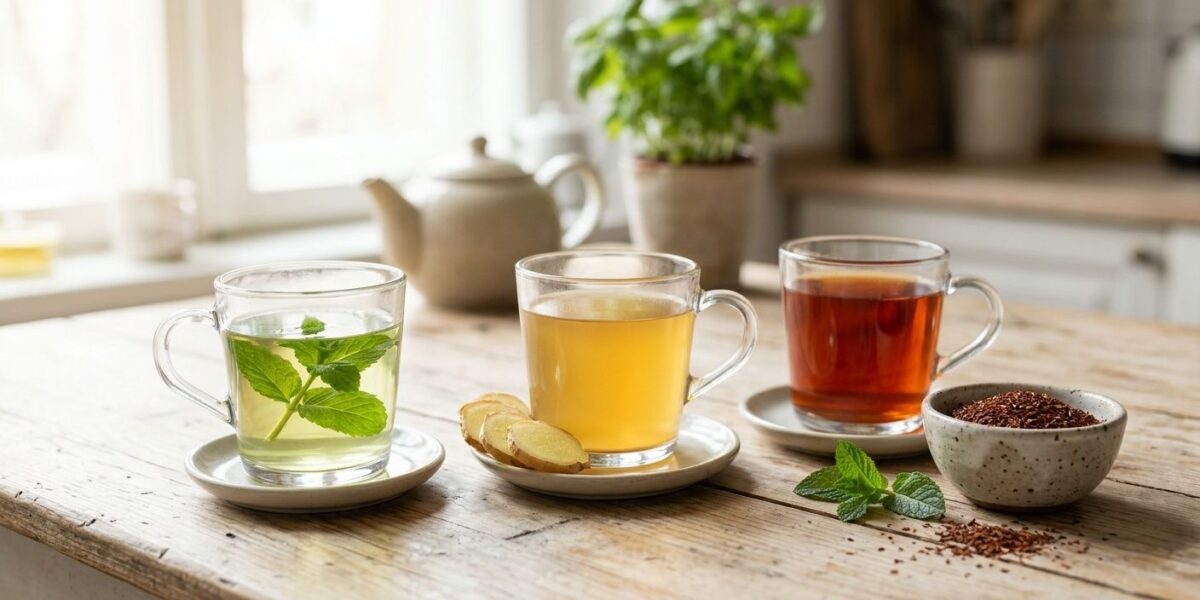
Tea is one of the few comforts people expect to keep when they start a low histamine diet, and then the lists start disagreeing. One site says green tea is fine, another says it blocks the enzyme that clears histamine, a third bans everything except water. If you are looking for the best tea for histamine intolerance, the honest answer is less dramatic than most lists suggest: plain herbal infusions made from a single plant are usually the easiest place to start, caffeinated tea is something to test rather than something to fear, and the teas most likely to cause trouble are the fermented, aged or heavily flavoured ones.
This guide sorts common teas into three groups (usually well tolerated, worth testing, and best skipped during elimination), explains where the warnings about black and green tea actually come from, and covers the safety notes that matter more than histamine for a few popular herbs, such as chamomile and licorice. Tolerance is individual, so treat every rating here as a starting point for your own testing rather than a verdict.
The short version. Peppermint, ginger, rooibos and other single-herb infusions are the usual first choices. Black, green, white and oolong tea are rated Moderate (test) on our food list, so most people pause them during elimination and bring them back one at a time. Kombucha, pu-erh and teas with citrus peel, strawberry pieces or vague “natural flavourings” are the ones to skip until you know how you react.
Why Tea Gets Flagged on Low Histamine Lists
Histamine in food mostly comes from bacteria acting on protein over time. That is why aged cheese, cured meat, leftovers and fermented foods sit at the top of every avoid list. A cup of brewed tea contains very little protein, and most tea leaves and dried herbs are not fermented by bacteria (with a few exceptions covered below), so the usual histamine-forming process does not really apply to freshly brewed tea.
Lab data back this up. A 2021 review in Nutrients compared ten published low histamine diets with the authors’ own database of amine levels in foods, and histamine was not detected in the small set of tea samples it included (Sánchez-Pérez and colleagues, Nutrients 2021). The same samples did contain small amounts of other amines. One of them, putrescine, is also broken down by DAO, and some researchers think such amines may compete with histamine, although this has not been shown. It is one possible explanation for why a few people notice symptoms after strong tea even though the tea itself is not a histamine source.
So why does tea appear on so many avoid lists? There are three separate reasons, and it helps to keep them apart.
- The DAO claim. Many lists say black, green and mate tea block diamine oxidase (DAO), the enzyme that breaks down histamine in the gut. This claim is repeated widely, but we could not find human studies confirming it. A 2021 review of histamine intolerance in Nutrients actually lists tea among drinks that are usually fine in normal amounts (Hrubisko and colleagues, Nutrients 2021). The evidence is thin in both directions, which is why we rate these teas as something to test rather than something to avoid forever.
- Caffeine. Caffeine can cause a racing heart, jitteriness, poor sleep and digestive upset on its own. Those symptoms overlap with histamine symptoms, so a reaction to a strong cup of black tea is not automatically a histamine reaction.
- What is added to the tea. Fruit pieces, citrus peel, flavourings, fermentation and long storage of brewed tea all change the picture more than the tea leaf itself.
Put together, this means the question is less “is tea safe?” and more “which tea, made how, and how much?”
Teas That Are Usually Well Tolerated
The teas below are single-plant infusions that appear on the “usually tolerated” side of most low histamine diets. None of them has been lab-tested for histamine in a way that lets anyone promise they are histamine free, and none of them treats histamine intolerance. They are simply low-risk drinks that let you keep a warm cup in your day while you work out your triggers.
| Tea | Caffeine | Usual starting point | Notes |
|---|---|---|---|
| Peppermint | None | Usually well tolerated | Can make heartburn worse in some people because it relaxes the valve at the top of the stomach. |
| Fresh ginger | None | Usually well tolerated | Easy to make from sliced fresh root. Popular for nausea. |
| Rooibos (red bush) | None | Usually well tolerated | Choose plain rooibos. “Green” unoxidised and red oxidised versions are both commonly used. |
| Honeybush | None | Usually well tolerated | Similar to rooibos, slightly sweeter. |
| Fresh mint, lemon balm, basil or thyme infusions | None | Usually well tolerated | Pick a few sprigs, pour over hot water, drink the same day. |
| Fennel seed | None | Usually well tolerated | Gently crushed seeds steeped for a few minutes. |
| Chamomile | None | Avoid if you react to ragweed or daisies | Related to ragweed. See the safety section below. |
Peppermint Tea
Peppermint is probably the most common caffeine-free tea in any kitchen, and it is widely used on low histamine diets. Many people drink it after meals for digestion. The one catch has nothing to do with histamine: peppermint can relax the muscle between the stomach and the oesophagus, so people with reflux sometimes find it makes heartburn worse. If you already have reflux, ginger or rooibos may suit you better.
Fresh Ginger Tea
Slice about a thumb-sized piece of fresh ginger, pour boiling water over it, and leave it for five to ten minutes. Ginger tea is easy to make fresh every time, which removes the question of how long a bag has been sitting in a cupboard. It is a popular choice when histamine flares come with nausea. If you take blood-thinning medicine, mention regular ginger use to your pharmacist, especially in larger amounts than a normal cup or two.
Rooibos and Honeybush
Rooibos comes from a South African shrub, not the tea plant, so it contains no caffeine. It brews to a deep red cup that works well for people who miss the colour and body of black tea, and it takes a splash of fresh milk well. Honeybush is another caffeine-free South African shrub with a naturally sweeter taste. Buy plain versions rather than blends: flavoured rooibos often contains orange peel, vanilla flavouring or dried fruit, which brings back the ingredients you are trying to test separately.
Fresh Herb Infusions
Some of the simplest teas come straight from the fridge or a windowsill pot. Fresh mint, lemon balm, basil and thyme all make pleasant infusions. Because they are made from fresh leaves and drunk straight away, there is no storage question at all. Lemon balm tastes lemony without containing any citrus, which makes it a useful swap for lemon tea while citrus is out of your diet.
Teas Worth Testing After Elimination
Black, green, white and oolong tea all come from the same plant, Camellia sinensis. They differ in how the leaves are processed, not in what they are. Our histamine intolerance food list rates all of them Moderate (test), in line with coffee. That means most people leave them out during the first weeks of elimination and then reintroduce one at a time.
Black Tea
Black tea is oxidised, not fermented. The leaves are rolled and exposed to air, which turns them dark through a chemical reaction rather than through bacterial activity. That distinction matters, because bacterial fermentation is what builds histamine in foods like sauerkraut and kombucha. Black tea also has the most caffeine of the common teas: according to the US Food and Drug Administration, a 12-ounce serving contains roughly 71 mg, about twice as much as green tea. If black tea bothers you, it is worth trying a weaker cup or a decaffeinated version before deciding the tea itself is the problem.
Green and White Tea
Green and white tea are the least processed teas: green tea is heated soon after picking to stop oxidation, and white tea is simply withered and dried. They usually contain less caffeine than black tea, though this varies by type and brewing. Green tea is the one most often accused of blocking DAO, but as explained above, that claim is not well supported in people. Test it like any other moderate food, ideally on a quiet day when the rest of your diet is simple.
Matcha
Matcha is powdered green tea whisked into water, so you drink the whole leaf rather than an infusion. A cup of matcha usually delivers more caffeine than a cup of brewed green tea, and that alone can explain a jittery reaction. If you want to test it, start with a small amount, and do not combine the test with other new foods.
Oolong
Oolong is partly oxidised and sits between green and black tea in taste and caffeine. It is tested the same way.
Yerba Mate
Mate is made from a South American holly, not the tea plant, and it is often lumped together with black and green tea on avoid lists. It contains a fair amount of caffeine. Some mate is smoked or aged during processing, which varies between brands. Treat it as a test food and keep it for later in reintroduction.
How to Test a Caffeinated Tea
- Wait until your symptoms have settled on your elimination diet. Our guide on how long to stay on a low histamine diet explains the usual timing.
- Choose one tea, plain, freshly brewed, with no added fruit or flavour.
- Drink a normal cup in the morning, so caffeine does not muddy your sleep that night.
- Note any flushing, headache, blocked nose, itching, racing heart or digestive symptoms over the next 24 hours.
- Repeat on another day before deciding. A single bad afternoon can be a coincidence.
- If the first cup goes well, try your usual amount over the following days, since tolerance often depends on dose.
Keep a simple note of what you drank, how strong it was and what else you ate that day. Patterns are much easier to see written down than remembered.
Teas Best Skipped During Elimination
Kombucha
Kombucha is tea fermented by a culture of bacteria and yeast for days or weeks. That fermentation step is exactly what most low histamine diets exclude. The Nutrients 2021 comparison found that fermented foods were the only food group every one of the ten diets it reviewed agreed on removing, and kombucha falls squarely into that group. Our article on healthy drinks high in histamine explains why kombucha, kefir and bone broth often cause trouble despite their gut-health reputation.
Pu-erh and Other Microbially Aged Teas
Pu-erh is the main true tea that is deliberately fermented by microbes and often aged for years. Its amine content is likely to vary between cakes and producers. It is best left out during elimination and tested late, if at all.
Fruit Teas and Flavoured Blends
Fruit teas are often the bigger problem than black tea. Many contain dried orange or lemon peel, strawberry, raspberry, pineapple or papaya pieces. These fruits are commonly listed as histamine liberators, meaning they are reported to trigger histamine release from the body’s own cells, even though the evidence for that effect is limited. Hibiscus-based blends are often bulked out with apple, rosehip and citrus peel. Hibiscus itself may lower blood pressure and many sources advise avoiding it in pregnancy, so check with your doctor if either applies to you. Read the ingredient list rather than the name on the front: a “berry” tea can be mostly hibiscus and apple, while a “lemon and ginger” tea may contain real lemon peel or only flavouring.
Chai
Chai blends combine black tea with spices such as cinnamon, cloves, cardamom and ginger. Cinnamon and cloves are rated Moderate (test) on our food list, so a chai teabag combines several test foods in one cup. If you love chai, test black tea on its own first, then add one spice at a time. Ready-made chai concentrates and lattes often add sweeteners, flavourings and long shelf storage, which makes them harder to judge.
“Detox” and Functional Blends
Blends sold for detox, sleep, immunity or “histamine support” often contain ten or more ingredients, some of them herbal extracts with real drug interactions. A long list makes it impossible to tell which ingredient caused a reaction. Single-herb teas give you much clearer answers.
Read the label for these ingredients: citrus peel, strawberry, raspberry, pineapple, papaya, “natural flavouring”, licorice root, black tea in a blend that looks caffeine free, and any fermented ingredient such as kombucha or apple cider vinegar.
Safety Notes That Matter More Than Histamine
Herbal teas are plants, and a few of them carry risks that have nothing to do with histamine. These deserve more attention than any histamine rating.
Chamomile and Plant Allergies
Chamomile belongs to the daisy family. The National Center for Complementary and Integrative Health notes that people allergic to related plants such as ragweed, chrysanthemums, marigolds and daisies are more likely to react to chamomile, and that severe allergic reactions, including anaphylaxis, are possible. It also reports interactions with some medicines processed by the liver and with warfarin, a blood thinner, and notes that little is known about chamomile in pregnancy and breastfeeding. If you have hay fever from weeds or take regular medicines, check with a pharmacist before making chamomile a daily habit. If you have already had an allergic reaction to ragweed, chrysanthemums or other daisy-family plants, avoid chamomile unless an allergist advises otherwise. Echinacea, calendula and dandelion, which often appear in blends, belong to the same family.
Licorice Root
Licorice root gives a sweet taste to many herbal blends, including some sold as “throat” or “digestion” teas. The National Center for Complementary and Integrative Health warns that glycyrrhizin from licorice root can cause serious effects such as irregular heartbeat and cardiac arrest, especially with large amounts or long-term use, and that even small amounts have been linked to severe effects in people with high blood pressure, heart or kidney conditions. It also states that large amounts in pregnancy are unsafe and that licorice interacts with corticosteroids. Many people do not realise how often licorice appears in blends. Check the ingredient list, and avoid regular licorice tea if you have high blood pressure, heart or kidney problems, are pregnant, or take steroid, blood pressure, diuretic or heart medicines.
Nettle Tea
Nettle is often promoted for histamine problems. Our review of stinging nettle histamine intolerance research explains that it has not been tested in histamine intolerance, and that nettle may interact with some medicines, including blood thinners, blood pressure medicines and diuretics. A cup of nettle tea is a food-level amount, but it is not a treatment.
Caffeine Limits
The FDA cites 400 mg of caffeine a day as an amount not generally linked to harmful effects in healthy adults, while noting that sensitivity varies a lot between people. If you are pregnant, trying to conceive or breastfeeding, ask your doctor or midwife how much caffeine is right for you. If you are pregnant or breastfeeding, check herbal teas with your midwife or doctor too. Caffeine can also worsen palpitations and anxiety, which some people with histamine problems already experience.
Tea and Medicines
Some medicines and supplements interact with tea or herbal ingredients. Green tea extracts or large amounts of green tea can interact with certain medicines, such as the blood pressure medicine nadolol, and several herbs affect blood thinners. If you take regular medication, show your pharmacist the teas you drink most often. Our article on medications that block DAO covers the medicines most often discussed in histamine intolerance. Never stop or change a prescribed medicine because of a tea list; talk to your doctor first.
Brewing and Storage Habits That Help
Because a cup of brewed tea contains so little protein, the time-and-bacteria problem that affects leftovers matters far less for tea than for food. A few habits still make your testing cleaner.
- Brew fresh. Make tea when you want to drink it. Freshly brewed tea is the cleanest test, and it tastes better.
- Keep iced tea short-lived. If you make a jug of iced herbal tea, keep it in the fridge and finish it within a day. Do not leave brewed tea at room temperature for hours.
- Store dry tea well. Keep tea and dried herbs in a sealed container, away from heat and damp. Throw out anything that smells musty or shows any sign of mould.
- Prefer simple bags or loose leaf. Pyramid bags with visible fruit pieces are usually flavoured blends.
- Watch what goes in the cup. Fresh milk is usually well tolerated. Lemon slices bring citrus back in. Honey and maple syrup are common sweeteners on low histamine diets.
- Use fresh water. Freshly boiled water gives a better taste and avoids the stale flavour of reboiled water.
Building a Daily Tea Routine
A practical routine during elimination looks something like this: rooibos with a splash of fresh milk in the morning instead of black tea, fresh ginger or peppermint after lunch, and a fresh herb infusion or plain hot water with a few mint leaves in the evening. That gives you warm drinks across the day without any of the teas that need testing.
Once your symptoms are steady, add back one caffeinated tea, test it as described above, and decide how much suits you. Many people end up with a cup or two of black or green tea a day and herbal teas the rest of the time. Others find that strong black tea on an empty stomach is the problem and that a weaker cup with breakfast is fine. The aim is a routine that works for you, not a rule that applies to everyone.
If you are also deciding about coffee, our guide to histamine intolerance coffee uses the same test-don’t-guess approach. For cold drinks, the low histamine smoothie recipes collection covers fruit choices that avoid the common liberators.
When a Reaction Is Not About the Tea
It is easy to blame the last thing you drank. Before you remove a tea for good, check what else happened that day. A cup of green tea after a lunch of leftover chicken, with a stressful afternoon and a poor night’s sleep, is not a clean test. Repeat the tea on a simple day with fresh food and see whether the same thing happens.
Also consider other explanations. Caffeine sensitivity, reflux from peppermint, a pollen allergy that cross-reacts with chamomile, or a reaction to an additive in a flavoured blend can all look like histamine intolerance. A doctor or dietitian can help you sort out which explanation fits, and a food and symptom diary makes that conversation much more useful.
When to See a Doctor
See your doctor if drinks regularly cause hives, swelling, wheezing, palpitations, fainting or ongoing digestive symptoms, if you are losing weight, or if your diet is becoming very restricted. Symptoms after drinks can come from allergy, reflux, heart rhythm problems or other conditions that need proper assessment.
Use prescribed adrenaline (epinephrine) and call emergency services straight away if a reaction includes swelling of the lips, tongue or throat, difficulty breathing or swallowing, wheezing, a hoarse voice, dizziness or fainting. These can be signs of anaphylaxis. Give adrenaline first if you have it, and call even if you feel better. Antihistamines are not a substitute.
Your Tea Questions, Answered
What is the best tea for histamine intolerance?
Plain single-herb infusions such as peppermint, fresh ginger, rooibos, honeybush and fresh mint are the usual first choices, because they contain no caffeine and no fermented or fruit ingredients. Tolerance is individual, so test any new tea on its own.
Is green tea bad for histamine intolerance?
Not necessarily. Green tea is often said to block the DAO enzyme, but that claim is not confirmed in human studies. Our food list rates it Moderate (test), so most people leave it out during elimination and reintroduce it later.
Can I drink black tea on a low histamine diet?
Black tea is oxidised rather than fermented, and histamine was not detected in tea samples in a 2021 analysis. It is still rated Moderate (test), partly because of its caffeine, so test a plain, freshly brewed cup after elimination.
Is chamomile tea low histamine?
Chamomile is often tolerated, but it is related to ragweed, so people with those plant allergies can react to it, sometimes severely. Avoid it if you have reacted to ragweed or daisy-family plants. It can also interact with warfarin, so check with a pharmacist if you take regular medicines.
Which teas should I avoid with histamine intolerance?
During elimination, skip kombucha, pu-erh and other microbially aged teas, fruit blends with citrus, strawberry or pineapple pieces, chai blends and teas with vague natural flavourings. Avoid regular licorice root tea if you have high blood pressure, heart or kidney problems, take steroid, blood pressure or diuretic medicines, or are pregnant.
Medical disclaimer: This content is for informational purposes only and does not constitute medical advice. Always consult a qualified healthcare provider before starting any supplement regimen.
→ Try the Histamine Load Calculator — find out if your daily food choices are pushing you over your histamine threshold.
→ Track your reactions with the Histamine Food Diary — identify your personal trigger foods automatically.
→ Ready to start? Use the 4-Week Elimination Diet Planner — interactive daily tasks with progress tracking.
→ Build your meal with the Low Histamine Meal Builder — instant histamine scoring as you select ingredients.